Monday, January 24, 2022

Week 16: The Battle of Hastings


Please watch: The Battle of Hastings

**********

For those interested in checking the sources, here are some primary document links:

Source: William of Malmesbury 

Latin Source

The Battle of Hastings

"Then King William came from Normandy into Pevensey, on the eve of the Feast of St. Michael, and as soon as they were fit, made a castle at Hastings market-town. Then this became known to King Harold and he gathered a great raiding-army, and came against him at the grey apple-tree. And William came upon him by surprise before his people were marshalled. Nevertheless the king fought very hard against him with those men who wanted to support him, and there was a great slaughter on either side. There were killed King Harold, and Earl Leofwine his brother, and Earl Gyrth his brother, and many good men. And the French had possession of the place of slaughter, just as God granted them because of the people's sins."
This terse entry in the Anglo-Saxon Chronicle (Worcester MS) for the year 1066 is the only contemporary English account of the Battle of Hastings, an event that can be better understood if one looks back to the millennium, when the country suffered wretchedly from Viking predation. "In every way," records the Anglo-Saxon Chronicle (Peterborough MS), "it was a heavy time, because they never left off their evil."
Æthelred
In 1002, twenty-four thousand pounds in Danegeld (tax) was paid "on condition they should leave off from their evil deeds." But then, indecisive and badly served by his counselors, and fearful for himself and his kingdom, Æthelred the Unready (a play on his name, Æthelred, "good counsel," and Unraed, "ill-advised") rashly ordered that "all the Danish men who were among the English race to be killed on St. Brice's Day [November 13]." This attack is mentioned in a later charter, which records the restitution made to a monastery in Oxford for the loss of its church, which had been destroyed during the massacre. It relates that the Danes,
"who had sprung up in this island, sprouting like cockle amongst the wheat, were to be destroyed by a most just extermination, and this decree was to be put into effect even as far as death, those Danes who dwelt in the afore-mentioned town, striving to escape death, entered this sanctuary of Christ, having broken by force the doors and bolts, and resolved to make a refuge and defence for themselves therein against the people of the town and the suburbs; but when all the people in pursuit strove, forced by necessity, to drive them out, and could not, they set fire to the planks and burnt, as it seems, this church with its ornaments and its books."
And all those who had taken refuge inside. (William of Jumièges is the first to mention the atrocities: women buried up to their waists and attacked by dogs, children dashed against door-posts.)
That same year, in hope that an alliance with the duchy would deny the Danes safe harbor, Æthelred married Emma, the young daughter of Richard I, Duke of Normandy. It was to no avail, and in 1007 thirty thousand pounds in Danegeld was paid. Ships were built, "more of them than there had ever earlier been in England in the days of any king" to defend the country, but it all came to naught. Wulfnoth (the father of Earl Godwin) actually took some of them and plundered the coast, himself. Others, in an attempt to capture the traitorous thegn, were driven ashore by a storm and their own ships burned. Hearing all this, Æthelred simply returned to London and, in the words of the Chronicler, "thus lightly let the whole nation's labour waste; and the deterrent in which the whole English race had confidence, was no better."
More tax was paid but it never was enough. The harrying continued until, in 1013, Sweyn Forkbeard, the king of Denmark, and his young son Cnut invaded England and "wrought the greatest evil that any raiding-army could do." London submitted and Æthelred and his queen, together with their children, the æthelings (princes) Edward and Alfred, fled to Normandy.
Only a few months later, however, Sweyn died and the exiled family returned. In 1015, Cnut came again to England, determined to reclaim the country for Denmark. Æthelred and his son by his first marriage, Edmund Ironside, resisted, but "it did not achieve any more than it often did before." The next year, "after great toil and difficulties in this life," the hapless king died. Edmund, too, died that year and in 1016 Cnut succeeded to the throne of England, taking the widowed Emma as his consort the next year, while her children remained exiled in Normandy.
The Succession
When Edward himself was recalled to England in 1041, he had been at the Norman court for twenty-four years. There, among his mother's family, he had made friends, with whom he surrounded himself when he became king the next year, especially Robert, who was appointed Archbishop of Canterbury in 1051. As a result, relates the anonymous author of the Vita Ædwardi Regis ("Life of King Edward"), "he offended quite a number of the nobles of his kingdom by means of another's fault. And for such reasons his realm gradually became disturbed." Especially resentful of the undue influence of these Norman favorites was the most powerful magnate in the land: Godwin, Earl of Wessex.
That same year, an incident at Dover almost brought the country to civil war. Eustace, Count of Boulogne, who was married to Edward's sister and later would fight at Hastings, had demanded accommodation for his entourage on the return to France. It was not given; there was a fight and men were killed on both sides. Edward demanded that Godwin punish the town for its insolence. When the earl refused, he was exiled, together with his sons. It was during this absence that Duke William is said to have visited the king and presumably then that Edward promised him the kingdom. Godwin returned in strength the next year and forced a reconciliation but died in 1053 to be succeeded by his son Harold.
Late in 1065, the Anglo-Saxon Chronicle (Abingdon MS) records that Harold's brother Tostig, who had ruled as Earl of Northumbria for ten years, was rejected by his thegns. They rebelled, killing his retainers and seizing the treasury, and demanded that Tostig be replaced "because he robbed God first, and then despoiled of life and of land all those he had power over." Harold acquiesced and Tostig was driven into exile, for which he never forgave his brother.
A devout man but a weak and ineffectual king, whose greatest achievement was the construction of Westminster Abbey, Edward the Confessor died on January 4, 1066. There was no successor nor were there any children. Having been sent abroad as a boy and deprived of his patrimony, his mother having married his father's mortal enemy, Edward regarded Edith his queen, Godwin's only daughter, more as "a beloved daughter" than a wife.
Edward was buried in the abbey he had founded. Hours later, Harold Godwin was himself crowned there, insisting, as William of Poitiers relates, that the kingdom was his by right, bequeathed to him by Edward on his deathbed, and that "the gift that anyone made at the point of death shall be held as valid." William, who had assumed that the throne was his, insisted that Harold was forsworn and prepared to invade. Indeed, such was William's claim that it was blessed by Pope Alexander II, who sent him a banner under which to march.
In April, a comet appeared, though Harold did not need to be told its portent. He had raised the greatest army and fleet that England had ever known. It consisted of his housecarls, the retainers of his own court, and those of the great earls and magnates, as well as the fyrd, a national militia which was conscripted in times of danger. Through July and August, Harold kept his men at the ready along the southern coast of England, waiting for an invasion that never came. In the words of the Chronicle (Abingdon MS), "in the end it was to no avail. Then when it was the Nativity of St Mary [September 8], the men's provisions were gone, and no one could hold them there any longer. Then the men were allowed to go home, and the king rode inland, and the ships were sent to London."
The fyrd was disbanded and the fleet sent around the coast to the Thames. But it was late in the season and a storm destroyed many of the ships. William's own ships, which had been assembled in the estuary of the Dives River just north of Caen, had been sent out as well and they, too, were caught in the storm. Some were lost and the others driven up the coast to the mouth of the Somme River. The result was that, either by accident or design, William had reduced the distance to the English coast almost by half.
But William was not the only claimant to the English throne. The Chronicle relates that, when Harold came ashore, he was informed that Harald Hardrada, the king of Norway, had landed in Northumbria and burned Scarborough to the ground, Snorri Sturluson telling how Harald had built a bonfire on the hill above the town and then pushed it down onto the thatched houses below.
Stamford Bridge
Aided by the northerly winds that kept William on the Norman coast, Harald crossed the North Sea from Bergen and was ravaging the countryside as he advanced upon York, the capital of Northumbria. There, he was met by the fyrd of Earl Edwin and Earl Morcar, who, records the Anglo-Saxon Chronicle (Worcester MS), "gathered from their earldom as great a force as they could get, and fought with that raiding-army and made a great slaughter." But the English were "killed and drowned and driven in flight; and the Norwegians had possession of the place of slaughter." The battle at Fulford was fought on September 20.
Harold hurried north, "by day and night, as quickly as he could gather his army." Incredibly, he arrived at York only four days later, his army strengthened by levies along the way.
"Then Harold our king came upon the Northmen by surprise, and encountered them beyond York at Stamford Bridge with a great raiding-army of English people; and there was that day a very hard fight on both sides. There was killed Harald [Hardrada] and Earl Tostig, and the Northmen who remained were put to flight, and the English fiercely attacked them from behind until some of them came to the ship, some drowned, and some also burnt, and thus variously perished, so that there were few survivors, and the English had possession of the place of slaughter."
So the Chronicle (Worcester MS) describes the Battle of Stamford Bridge. A more vivid account is provided by Snorri in his saga of Harald Hardrada.
It was a hot, sunny day when Harald, having had his morning meal, ordered his men ashore. A third were to stay on board to guard the ships, while the others, their heavy hauberks left behind, marched toward York "in excellent good spirits." But instead of defeated townsmen coming to offer hostages, they saw a cloud of dust raised by approaching horses and the glint of shields and shining coats of mail, and "it looked like gleaming ice as the weapons shone."
As his men drew up in a defensive ring, Harald was thrown from his horse. Harold Godwin noticed and asked who had fallen. When told that it was the King of Norway, he replied, "A big man and stately; but more likely his good luck has deserted him." Rather than fight his brother, Harold offered to return Northumbria to Earl Tostig. Asked what part of England would be granted to Harald, he was told "seven feet of English soil or so much more as he is taller than other men." Tostig was chastised for having let the king escape but replied that "I would rather that he slay me than I him."
Snorri's mistakenly recounts that the English fought on horseback and, when the Norwegians broke their shield-wall to purse them, turned and rode them down. Harald was said to have raged like a beserker until he, too, was killed by an arrow in the throat. Men from the ships arrived but were so tired from the march that some died from sheer exhaustion. Others, enraged, threw off their hauberks and, unprotected, died all the more readily.
The Norse refused to surrender, and the battle lasted until it was too dark to kill any more. It was the worst defeat ever inflicted on the Norse. Almost sixty years later, Orderic Vitalis recorded that "a great mountain of dead men's bones still lies there and bears witness to the terrible slaughter on both sides." Magnanimously, Harold allowed those who had been guarding the ships to live. Of the three hundred ships said to have sailed to England, only twenty-four were needed to return the survivors home.
(Although the Abingdon MS of the Anglo-Saxon Chronicle ends with the Battle of Stamford Bridge, one other incident was added later. It tells of a Norwegian who stood alone on the bridge, holding it against the English advance "so that they could not cross the bridge nor gain victory." He was not dislodged until someone drifted unseen beneath it and stabbed him from below.)
The next day, the wind changed. For the first time in two months, it began to blow steadily from the south. And the day after that, unknown to Harold, William and his army began to embark for England. Harold had guarded the coast all summer. Now, only three weeks before, the fyrd had gone home and he was two hundred and fifty miles away, having fought one of the bloodiest battles in England's history.
On September 28, the Normans would come ashore at Pevensey unopposed.
Hastings
Harold rushed south to London, where, says Orderic, he "sent far and wide to summon the populace to war." The Normans were devastating his former earldom of Wessex and, after waiting in vain for the northern earls to join him, Harold marched his exhausted troops to Hastings, perhaps in the hope that another sudden strike would be victorious.
It is difficult to estimate the number of men and horses that had landed, but, if there were as many as could be placed on the battlefield, then William might have had seven thousand men, comprising perhaps three thousand cavalry, a thousand archers, and the rest infantry. It was the horses that were unexpected. Though the English rode to battle on horses, as they had done at Maldon seventy-five years earlier, they dismounted and fought on foot.
Harold's army comprised at least as many men but had no cavalry and few archers. His housecarls were formidable warriors, "so valiant," Snorri relates, "that one of them was better than two of Harald's best men," but many had been lost at Stamford. And yet, even though John of Worcester chastises Harold for advancing before even a third of his army had assembled, many in the fyrd thought the field already so congested that they left before the battle even began.
The English occupied the high ground along the crest of a ridge on the road to London. It was a strong defensive position, well suited for the Anglo-Saxon shield-wall. The Normans were arrayed below in three divisions: Bretons on the left; the Normans under Duke William and his half-brother Bishop Odo in the center; and the French on the right, together with other mercenaries and adventurers. Each division, in turn, was comprised of three arms: archers in the front to weaken the enemy, foot soldiers to break it up, and behind them all, mounted knights to ride down the scattered ranks.
It was there on the morning of October 14, that William "came upon him by surprise before his people were marshalled." The battle began with the blare of trumpets, the Normans initiating the attack with a volley of arrows. As the archers fell back, the foot-soldiers advanced, but they were repulsed, says William of Poitiers, by a fusillade of "javelins and missiles of various kinds, murderous axes and stones tied to sticks." As the battlecontinued, mounted knights moved forward, but they too were driven back.
There was panic, as first the Bretons and then the whole Norman line reeled and began to give way, fearful that William, himself, had been killed. Pursued by the Saxon fyrd opposite them, they rallied only when William rode into the fray and revealed himself to be alive. Exhorting his men to fight, the English who had broken rank were cut off and annihilated.
Perhaps if the rest of the English had advanced at that moment or if there had been a deliberate retreat to the forest behind them, the outcome of the battle would have been different. Or if they earlier had laid waste to the countryside, denying the Normans fresh supplies while waiting for the northern fyrd to reassemble, which it never did. It was late in the season; reinforcements could not be sent, and the English would become only stronger. But Harold was passive, even fatalistic, and never ordered a concerted attack. On foot, he may not have been able to command such a large force, unlike the Normans, whose three divisions, each with its three arms, were more mobile. Or it may be that Harold was disheartened by the realization that he was under papal interdict and had been excommunicated.
The fighting continued throughout the day, the Normans varying their attack, the English "standing firmly as if fixed to the ground." So stalwart was the English shield-wall that William of Poitiers marveled that "the dead by falling seemed to move more than the living," the wounded unable to extricate themselves from the ranks of their companions.
Remembering what had happened before, William then is said to have ordered his knights to feign retreat. Again, the undisciplined men of the fyrdcharged downhill in pursuit. And again they were trapped and killed, as the cavalry wheeled their horses and turned on them. Dusk now was approaching and the English were exhausted. There was no hope of respite or relief, and Harold and his brothers, Gyrth and Leofwine, had been killed.
Finally, the shield-wall broke. "Some lay helplessly in their own blood, others who struggled up were too weak to escape. The passionate wish to escape death gave strength to some. Many left their corpses in deep woods, many who had collapsed on the routes blocked the way of those who came after."
There was a last stand among a broken rampart and rough ground, where, in the gloom and long grass, the pursuing Normans tripped and fell, "one on top of the other," says Orderic, "in a struggling mass of horses and arms," to be slaughtered by the English on the other side of the ravine. But it was not enough; the battle had been lost. And "the mangled bodies that had been the flower of the English nobility and youth covered the ground as far as the eye could see."
On Christmas Day 1066, less than three months after landing at Pevensey, William was crowned king of England. At the coronation, William of Poitiers writes that the English "all shouted their joyful assent, with no hesitation, as if heaven had granted them one mind and one voice." The Normans added their own voices as well, and the guards outside the Abbey, "hearing the loud clamour in an unknown tongue, thought some treachery was afoot and rashly set fire to houses near to the city." The fire spread from house to house, says Orderic, as those in the congregation frantically rushed outside, some to fight the fames, others to loot. Only the bishops and a few clergy remained to complete the consecration of the new king, who was seen to be "trembling from head to foot."
So began William's reign: with fires burning all around him. And so would England burn for five more years until it finally was subjugated. Theplundering of the country's wealth would begin immediately.


"When King Cnute had reigned for twenty years, he departed this life at Shaftesbury and was buried at Winchester in the Old Minster. A few words must be devoted to the power of this king. Before him there had never been in England a king of such great authority. He was lord of all Denmark, of all England, of all Norway, and also of Scotland. In addition to the many wars in which he was most particularly illustrious, he performed three fine and magnificent deeds....The third, that when he was at the height of his ascendancy, he ordered his chair to be placed on the sea-shore as the tide was coming in. Then he said to the rising tide, 'You are subject to me, as the land on which I am sitting is mine, and no one has resisted my overlordship with impunity. I command you, therefore, not to rise on to my land, nor to presume to wet the clothing or limbs of your master.' But the sea came up as usual, and disrespectfully drenched the king's feet and shins. So jumping back, the king cried, 'Let all the world know that the power of kings is empty and worthless, and there is no king worthy of the name save Him by whose will heaven, earth and sea obey eternal laws.' Thereafter King Cnut never wore the golden crown on his neck, but placed it on the image of the crucified Lord, in eternal praise of God the great king. By whose mercy may the soul of Kng Cnut enjoy rest."
Henry of Huntingdon, Historia Anglorum (VI.17)


The Anglo-Norman historians, together with the Bayeux Tapestry, provide the primary sources for the Battle of Hastings. Two other anonymous sources are important but vexing.


References: The Anglo-Saxon Chronicle (1996) translated and edited by Michael Swanton; The Gesta Normannorum Ducum of William Jumièges, Orderic Vitalis, and Robert of Torigni (1992) edited and translated by Elisabeth M. C. Van Houts (Oxford Medieval Texts); The Gesta Guillelmi of William of Poitiers (1998) edited and translated by R. H. C. Davis and Marjorie Chibnall (Oxford Medieval Texts); The Ecclesiastical History of Orderic Vitalis (1969) edited and translated by Marjorie Chibnall (Oxford Medieval Texts); Encomium Emmae Reginae (1949/1998) edited by Alistair Campbell and introduction by Simon Keynes; William of Malmesbury: Gesta Regum Anglorum: The History of the English Kings (1998) edited and translated by R. A. B. Mynors, R. M. Thomson, and M. Winterbottom (Oxford Medieval Texts); The Chronicle of John of Worcester: The Annals from 450 to 1066 (1995) edited by R. R. Darlington and P. McGurk, translated by Jennifer Bray and P. McGurk (Oxford Medieval Texts);Snorri Sturluson: Heimskringla: History of the Kings of Norway (1964) translated by Lee M. Hollander; King Harald's Saga: Harald Hardradi of Norway (1966) translated by Magnus Magnusson and Hermann Pálsson (Penguin); The Carmen de Hastingae Proelio of Guy, Bishop of Amiens(1972) edited by Catherine Morton and Hope Muntz (Oxford Medieval Texts); Henry, Archdeacon of Huntington: Historia Anglorum: The History of the English People (1996) edited and translated by Diana Greenway; The Life of King Edward Who Rests at Westminster: Attributed to a Monk of St. Bertin (1992) edited and translated by Frank Barlow (Oxford Medieval Texts).
William the Conqueror (1964) by David C. Douglas; Historical Writing in England c.550 to c.1307 (1974) by A. Gransden; The World of Orderic Vitalis (1984) by Marjorie Chibnall (Oxford); English Historical Documents c. 500-1042 (1979) edited by Dorothy Whitelock; English Historical Documents 1042-1189 (1953) edited by David C. Douglas and George W. Greenaway; 1066: The Year of the Conquest (1978) by David Howarth;The Year of the Conquest (1966) by Alan Lloyd; The Battle of Hastings (1998) by Jim Bradbury; William I and the Norman Conquest (1965) by Frank Barlow; Edward the Confessor (1970) by Frank Barlow; Reassessing Anglo-Saxon England (1996) by Eric John; The Bayeux Tapestry: A Comprehensive Survey (1965) edited by Sir Frank Stenton; The Bayeux Tapestry (1985) by David M. Wilson; The Bayeux Tapestry (1994) by Wolfgang Grape; Anglo-Saxon Art: A New Perspective (1982) by C. R. Dodwell.


Source:  http://penelope.uchicago.edu/~grout/encyclopaedia_romana/britannia/anglo-saxon/hastings/hastings.html. 

Sunday, November 14, 2021

Week 11

                             Planctus de obitu Karoli


Please note: The homework for this week has been canceled.  Instead of a viva we will be reviewing for our post-break tests, the listening exam, textbook exam, and viva voce. Please review your work for class and be sure to have your viva notecards ready and with you during our class time. 

Here is a study guide for the Christendom midterm.

Friday, October 29, 2021

Week 9


Life of Muhammad


Muhammad was the son of Abdullah and Amina. He never knew his father who died while Amina was still pregnant (69). At one point in his childhood, Muhammad and his brother were with some sheep behind their tents when Muhammad’s brother ran for help saying that something was wrong with Muhammad. When asked what was wrong, Muhammad, “standing up with a livid face,” said, “Two men in white raiment came and threw me down and opened my belly and searched therein for I know not what.” They took him back to the tent and his [adoptive?] father said, “I’m afraid that this child has had a stroke.” Muhammad’s mother asked her other son if he feared that a demon had possessed Muhammad and he answered yes. Muhammad’s mother replied that “no demon had any power over her son who had a great future before him” (72).

When Muhammad was six years old his mother died and he was left in the care of his grandfather (73). Two years later his grandfather died and he went to live with his uncle, Abu Talib (79) who stood by Muhammad and protected him even into adulthood.

When Muhammad grew up, an older and very wealthy merchant woman named Khadija heard of his “honorable character” and hired him to take her goods to Syria (82). She would later become Muhammad’s first wife and faithful supporter.

When Muhammad reached the age of forty he began to feel like God was sending him “as an evangelist to all men” (104). He used to travel out to the “glens of Mecca” where “no house was in sight” and he began to hear voices saying “Peace unto thee, O apostle of Allah” but there was nothing there except “trees and stones.”

Once a year during the month of Ramadan, Muhammad would “pray in seclusion and give food to the poor that came to him.” After “he returned from his seclusion,” before returning home, “he would go to the Ka’ba,” the black square-shaped temple in Mecca, and “walk around it seven times or as often as it pleased God; then he would go back to his house until the year when God sent him, in the month of Ramadan” (105).

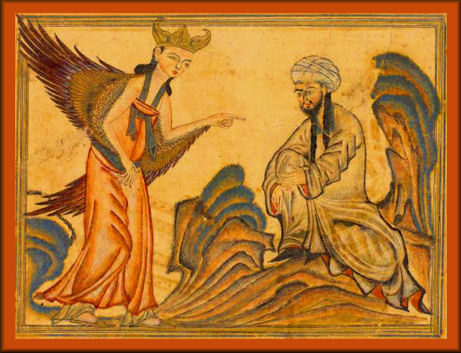
One day, Muhammad said that while he was sleeping, Gabriel came to him with something that had writing on it, and said “Read!” According to Muhammad,

“I said, ‘What shall I read?’ He pressed me with it so tightly that I thought it was death; then he let me go and said, ‘Read!’ I said, ‘What shall I read?’ He pressed me with it again so that I thought it was death; then he let me go and said ‘Read!’ I said, ‘What shall I read?” He pressed me with it the third time so that I thought it was death and said, “Read!’ I said, ‘What then shall I read?—and this I said only to deliver myself from him, lest he would do the same to me again. He said, “Read in the name of thy Lord who created, Who created man of blood coagulated. Read! Thy Lord is most beneficient, Who taught by the pen, Taught that which they knew not unto men.’ So I read it and he departed from me (106).

Muhammad woke up and began to wonder if he was demon possessed. Afraid that the local Quraysh tribes would think he was indeed demon possessed he considered throwing himself down a mountain to kill himself but on the way up the mountain he heard a voice saying he was the apostle of God (105-106). Instead of committing suicide, Muhammad decided to tell his wife, Khadija, of his dream and of his fear of demon possession (106). Khadija sought advice from her cousin who was a Christian. When he heard the story he assured her that Muhammad must be a prophet (107).

After that, Muhammad began receiving revelations. Khadija accepted his revelations as true, became his first convert, and helped him in his work (111). The first male to become a Muslim was Ali, at only 10 years old (114). Soon, however, men and women began to accept Islam in large numbers “until the fame of it was spread throughout Mecca” (117).

When the early Muslims prayed they often went to the glens around Mecca so their people could not see them praying. While Sa’d b. Abu Waqqas was praying with other Muslims “a band of polytheists” came by and “rudely interrupted them.” “They came to blows” and “the first blood to be shed in Islam” occurred when “Sa’d smote a polytheist with a jawbone of a camel and wounded him” (118).

Most Meccans did not turn against the Muslims until Muhammad “spoke disparagingly of their gods.” Then “they took great offense and resolved unanimously to treat him as an enemy.” But Muhammad was protected by his powerful uncle, Abu Talib (118). Yet “They were always talking about him and inciting one another against him” (119):

‘Then the Quraysh incited people against the companions of the apostle who had become Muslims. Every tribe fell upon the Muslims among them, beating them and seducing them from their religion. God protected His apostle from them through his uncle” (120)

Many of the Quraysh “called him a liar, insulted him, and accused him of being a poet, a sorcerer, a diviner and of being possessed.” Muhammad, however, continued to proclaim his message and condemn their religion (130).

One day while prominent men of Mecca were talking about him, Muhammad began to walk around the temple of Mecca known as the Ka’ba. As he passed by these men “they said some injurious things about him.” When he passed by them the second time, “they attacked him similarly.” “Then he passed a third time, and they did the same.” This time Muhammad stopped and swore by God that he would bring them slaughter (131)!

Islam was spreading throughout Mecca in the tribes of the Quraysh, “though Quraysh were imprisoning and seducing as many of the Muslims as they could” (133). Since persecution wasn’t working, the Meccans tried to shut Muhammad up by negotiation. If he wanted money, they would make him rich. If he wanted honor or sovereignty, they would make him a prince or even a king. If he was demon possessed, “they would exhaust their means in finding medicine to cure him.” Muhammad would have none of it so they told him that they would not leave him alone “until we destroy you or you destroy us” (134).

The Quraysh continued to persecute the Muslims, “beating them, allowing them no food or drink, and exposing them to the burning heat of Mecca.” “Some gave way under the pressure of persecution, and others resisted” (143). For example, Bilal was a faithful Muslim slave who belonged to Umayya b. Khalaf. Umayya would take his Muslim slave out to the desert in the hottest part of the day, throw him on his back, and place a heavy rock on his chest saying, “You will stay here till you die or deny Muhammad” and worship the goddesses of Mecca (144).

One day Abu Bakr, one of Muhammad’s most faithful followers who would eventually be Muhammad’s successor, saw this slave being tortured. Abu Bakr said, “Have you no fear of God that you treat this poor fellow like this? Umayya responded saying, “You are the one who corrupted him, you save him from his plight…” (144). Abu Bakr said he had a black slave who was not Muslim and was stronger than the slave being persecuted. He offered to trade slaves and the deal was accepted (144).

Although Muhammad escaped much of the persecution through the protection of his powerful uncle, Muhammad could not protect his followers so he suggested that they go to Abyssinia in Africa whose Christian king, Muhammad told them, “will not tolerate injustice.” Many Muslims followed Muhammad’s advice (146).

When the Quraysh heard this, they sent men to Abyssinia to force the Muslims to return. The case came before the king who said he would not surrender the Muslims to them. He then summoned the Muslims and asked them about their religion. They told him that they had been “an uncivilized people, worshipping idols, eating corpses, committing abominations, breaking natural ties, treating guests badly, and our strong devoured our weak” (150-152).

They said that Muhammad has summoned them to acknowledge God’s unity, to worship God “and to renounce the stones and images” which they had formerly worshiped. Muhammad had forbidden them from committing abominations, speaking lies, devouring the property of orphans, or vilifying chaste women. On the other hand, they were commanded to worship God alone and not to associate anything with Him,” and to observe “orders about prayer, almsgiving, and fasting” (150-152).

Meanwhile, Muhammad became very pained about his estrangement from his people and “longed that there should come to him from God a message that would reconcile his people to him.” It wasn’t long before Muhammad got a revelation saying that the three goddesses of Mecca, al-Lat, al-‘Uzza and Manat were exalted and that their intercession was approved by Allah. The Quraysh “were delighted and greatly pleased at the way in which he spoke of their gods” (167).

Muslims, however, thought there must be some mistake since this seemed to contradict the essence of Muhammad’s monotheism. The issue was soon resolved when Muhammad got another revelation saying that Satan, not God, had told him the goddesses’ intercession was approved. Muhammad repented and “God annulled what Satan had suggested” (179).

One day Muhammad reported that he and Gabriel had been carried away from the “mosque at Mecca” to “the Masjid al-Aqsa” in Jerusalem where “he found Abraham, Moses and Jesus among a company of the prophets.” Muhammad “acted as their imam in prayer.” Two containers were brought to him, one with milk and one with wine. When Muhammad drank the milk and left the wine, Gabriel said Muhammad had been “rightly guided” because, he was told, “wine is forbidden to you.” Muhammad then returned to Mecca in the morning and told the Quraysh people of his trip. “Most of them said…this is plain absurdity!” In fact, many Muslims even gave up their faith because of the story (181-183).

When asked what he thought of Muhammad now, Abu Bakr said if he says it, its true. Muhammad’s wife Aisha used to say that Muhammad’s body “remained where it was but God removed his spirit by night.” A woman named “Hind” said,

“The apostle went on no night journey except while he was in my house. He slept that night in my house. He prayed the final night prayer, then he slept and we slept. A little before dawn the apostle woke us, and when we prayed the dawn prayer he said…I prayed with you last evening prayer in the valley as you saw. Then I went to Jerusalem and prayed there” (183-184).

She tried to persuade Muhammad not to tell anyone for fear that they would insult him but he wouldn’t listen. She asked her black slave to follow Muhammad and listen to what he said. Muhammad reported his experience and, when asked for proof, he said that he passed a certain caravan in a particular valley (183-184).

Muhammad’s wife Khadija and his uncle Abu Talib died in the same year. Khadija had been a faithful supporter who listened to his troubles while Abu Talib had been his protector. The Quraysh began to treat Muhammad “in an offensive way which they would not have dared to follow in his uncle’s lifetime”. Someone even threw dust on Muhammad’s head (191).

In the following year—“before the duty of making war was laid upon them”—twelve of Muhammad’s helpers met at al-Aqaba and pledged themselves to Muhammad, promising not to steal, not to commit fornication, not to kill their offspring, not to slander their neighbors, and not to disobey Muhammad in what was right. They understood that if they fulfilled these, paradise would be theirs but if they “committed any of those sins it was for God to punish or forgive as He pleased” (199).

“When God gave permission” for Muhammad to fight, “the second [meeting at] Aqaba contained conditions involving war” which were not part of the first pledge. The men “Now they bound themselves to war against all” for Muhammad and God (208). Muhammad received a revelation saying, “Fight them so that there be no more seduction” away from Islam and “Until God alone is worshiped” (213).

After this permission to fight, the Ansar Clan pledged their support to Muhammad and the Muslims began to emigrate from Mecca to Medina in order to link up with the Ansar. Abu Bakr and Ali stayed behind in Mecca with Muhammad for a time, until he received permission from God to go to Medina (213).

Once Muhammad emigrated to Medina he made a “friendly agreement” with the Jewish tribes of Yathrib (Medina). Any disputes were to be resolved by Muhammad (232). Once Muhammad was established in Medina he instituted prayers, fasting, alms tax, legal punishments and spelled out that which was forbidden and prescribed (235).

Some Jewish rabbis, however, were hostile to Muhammad, annoying him with questions, introducing “confusion,” and trying to extinguish Islam. “They were joined by men from al-Aus and al-Kihazraj who had obstinately clung to their heathen religion” (239-240). Some Jewish rabbis came to Muhammad and said they would follow him if he would answer some questions. Their first question was, “Why does a boy resemble his mother when the seed comes from the man? Muhammad answered that “a man’s seed is white and thick while a woman’s is yellow and thin, and the likeness goes with that which comes to the top” (255).

“Some Muslims remained friends with the Jews because of the tie of mutual protection and alliance which had subsisted between them.” Muhammad, however, received a revelation forbidding Muslims to take Jews as intimate friends. He explained that the Jews would corrupt them and that the Jews had hatred concealed in their breasts. Muhammad told Muslims that while they believe in the Jews' holy books, the Jews didn’t believe in the Muslim’s holy book so “you have more right to hate them than they to hate you” (262-263).

One day Abu Bakr went to a Jewish school and called on one of their Rabbis to become a Muslim. The Rabbi’s response enraged Abu Bakr who hit the Rabbi in the face saying “Were it not for the treaty between us I would cut off your head.” The Rabbi complained to Muhammad and Muhammad asked Abu Bakr about it. Abu Bakr said the Rabbi had blasphemed but the Rabbi denied it. Muhammad then received a revelation supporting Abu Bakr (263).

One day when a Jewish man was brought to Muhammad on the charge of committing adultery, Muhammad ordered both of them to be stoned. “When the Jew felt the first stone he crouched over the woman to protect her from the stones until both of them were killed" (266-267).

Thirteen years after his call, Muhammad “prepared for war in pursuance of God’s command to fight his enemies and to fight the polytheists” (280). At first Muhammad made several raids on the Quraysh, including the first raid on Badr, but returned to Medina without fighting (281-286).

One day Muhammad sent Abdullah b. Jahsh and eight other Muslims with orders to “Lie in wait for Quraysh and find out for us what they are doing….” A Quraysh caravan came by and the Muslim raiders “decided to kill as many as they could of them and take what they had.” When they returned to Muhammad he rebuked them for fighting during the sacred month. Muhammad, however, later received a revelation relieving them “of their anxiety” in the matter. Muhammad took one-fifth of the booty and rewarded the raiders out of what was left over (288).

Muhammad then heard that a large caravan of Quraysh loaded with money and merchandise was coming from Syria led by Abu Sufyan b. Harb. Muhammad ordered the Muslims to attack the caravan, an attack which took place near the water of Badr. Muhammad encouraged his men saying that all those fighting “with steadfast courage advancing not retreating” would be rewarded with paradise if killed in the battle. When Muhammad saw them coming he cried, “O God, here come the Quraysh in their vanity and pride contending with Thee and calling Thy apostle a liar…Destroy them this morning!” Muhammad’s men routed their foe, killed many of their chiefs, and captured many of their nobles in this battle of Badr (289-294).

Muhammad then divided the booty including the captives equally among the Muslims (307). As Muhammad ordered one of the captives to be killed the captive pleaded, “Who will look after my children?” “Hell,” replied Muhammad, and the man was executed (308). Muhammad then divided the prisoners among his companions, telling them to treat them well (309).

One day Muhammad received a revelation saying, “I am with you so strengthen those that believe…I will cast terror into the hearts of those who disbelieve, so strike off their heads and cut off their fingers, because they oppose God and His apostle.” The revelation went on to say that Muslims on the march who turn back in the face of the unbelievers are destined for hell (322).

In another revelation, Muhammad heard, “O Prophet, exhort the believers to fight. If there are twenty steadfast ones among you they will overcome two hundred, and if there are a hundred of you they will overcome a thousand unbelievers for they are a senseless people.” Hearing that twenty Muslims were to fight two hundred enemy and that a hundred Muslims were to fight a thousand was quite a shock to the Muslims! Muhammad, however, soon received another revelation canceling this one, saying instead that if their forces were less than half of the enemy’s they could withdraw and not fight (326).

Muhammad then made some more raids but returned to Medina without having to fight (360-362).

Meanwhile there was the affair of B. Qaynuqa so Muhammad assembled the Jews in their market and warned them of vengeance. They told Muhammad that he should not be deceived by the fact that he had won a battle against people who had no knowledge of war and that if Muhammad fought them he would find that they were real men! Muhammad then received a revelation about them: “Say to those who disbelieve: you will be vanquished and gathered to hell” (363).

After the Muslim attack at Badr, the Quraysh were then “afraid to follow their usual route to Syria” so they went by the Iraq route. Muhammad then sent a raiding party led by Zayd to meet one of the caravans which was transporting a large amount of silver. The men of the caravan got away, but Zayd captured its contents and brought the spoil to Muhammad (364).

Muhammad heard that Ka’B b. Al-Ashraf had composed poetic verses insulting Muslim women so Muhammad asked who would rid him of Ka’B. The response came from Muhammad b. Maslama who said he would kill the man but would have to tell lies. Muhammad told him to kill Ka’B if he could and to say whatever he needed. When the Muslims came to Ka’B’s castle he suspected nothing. After some time Muhammad b. Maslama cried, “Smite the enemy of God!” He thrust his dagger into Ka’B’s body and “bore down upon it until I reached his genitals, and the enemy of God fell to the ground.” This attack “cast terror among the Jews, and there was no Jew in Medina who did not fear for his life” (367).

On another occasion, Muhammad said, “Kill any Jew that falls into your power”. Muhayyish b. Mas’ud obeyed Muhammad’s command and killed a Jewish merchant. A man named Huwayisa began to beat Muhayyish saying that much of their wealth came from this merchant. Muhayyish responded saying if Muhammad ordered him to cut off Huwayisa’s head, he would have done so. Huwayisa said that any religion that had this kind of power was wonderful, and he became a Muslim (369).

In one of the battles, the “Muslims were put to flight and the enemy slew many of them.” An enemy got to Muhammad, hitting him in the face with a stone, breaking one of his teeth and injuring his lip so that blood was running down his face. Muslims came to Muhammad’s aid and Muhammad ordered them to bring the attacker to him. The attacker “died with his face on” Muhammad’s foot (380).

After the battle, Utba and some women began to mutilate the bodies of the dead Muslims. “They cut off the ears and noses” and a woman named Hind made these body parts into “anklets and collars.” “She cut out Hamza’s liver and chewed it, but she was not able to swallow it and threw it away.” “Then she mounted a high rock and shrieked at the top of her voice: We have paid you back for Badr…” (385).

When Muhammad found Hamza “with his belly ripped up and his liver missing and his nose and ears cut off” he said, “If God gives me victory over Quraysh in the future I will mutilate 30 of their men.” Muhammad later pardoned some enemies and forbid mutilation (387). When he got home Muhammad handed his sword to his daughter Fatima, saying, “Wash the blood from this daughter for by God it has served me well today” (389).

When Muhammad went to B. al-Nadir to seek help in getting revenge for a murder, the men of B. al-Nadir agreed to help but then decided to drop a rock from the top of a building on Muhammad’s head. Muhammad discovered the plot, went back to Medina and ordered his followers to prepare for war. The Jews of al-Nadir took refuge in their forts” so Muhammad “ordered that the palm-trees should be cut down and burnt.” The men of al-Nadir called out to Muhammad, “you have prohibited wanton destruction… Why then are you cutting down and burning our palm-trees?” Eventually, the Jews reached an agreement with Muhammad that he would spare their lives and allow them to flee with whatever they could carry on their camels. Everything left behind became Muhammad’s personal property but “he divided it among the first immigrants” (437-438). After the attack on al-Nadir, Muhammad stayed in Medina while sending out several other raiding parties (445-449).

A group of Jews went to the Quraysh in Mecca and “invited them to join in an attack” on Muhammad in order to get rid of him. The Quraysh were eager to take part. When Muhammad heard about their plans, he had a trench built around Medina, even working on it himself. He encouraged his Muslim followers “with the hope of reward in heaven.” Some Muslims, however, began to sneak away to their families without Muhammad’s permission. Muhammad gave a speech warning them to “beware lest trouble or a painful punishment befall them.” Then the Quraysh laid siege to Medina with 10,000 troops against Muhammad’s 3,000. The situation for the Muslims “became serious and fear was everywhere” (451-453).

The siege lasted for nearly a month when some of the Quraysh beat their horses into dashing through a narrow part of the trench. Among them was Amr, the uncle of Muhammad’s friend Ali. Ali challenged Amr to dismount and Amr replied, “O son of my brother, I do not want to kill you.” Ali replied, “But I want to kill you.” Amr was enraged and “aimed a blow which cut deeply into the shield so that the sword stuck in it and struck his head.” But “Ali gave him a blow on the vein at the base of his neck and he fell to the ground.” Eventually, distrust between the attacking tribes caused them to abandon the siege against Muhammad and return home (454-460).

One day Muhammad received a revelation saying, “God commands you, Muhammad, to go to B. Qurayza” because God was about “to shake their stronghold.” Calling the Jews of Qurayza “brothers of monkeys,” Muhammad laid siege to their forts for twenty-five nights. The people of Qurayza finally surrendered to Muhammad who confined the captives in Medina while he had trenches dug in the marketplace. Muhammad then ordered the execution of every adult man of Qurayza. The captive Jews were brought out to the trenches in batches and the Muslims cut off their heads—estimates ranged from 600 to 900 men in all. Muhammad then divided their property, wives, and children among his Muslim followers after selling some of them for horses and weapons and taking one-fifth for himself. Muhammad also chose “one of their women for himself.” He had proposed marriage to her but she “clung to Judaism.” She remained under his power until her death (461-466).

After “the fight at the trench and the affair of the B. Qurayza were over, the matter of Sallam b. Abu’l-Haqayq…came up in connection with those who had collected the mixed tribes together against” Muhammad. Khazraj asked for Muhammad’s permission to kill Sallam who was in Khaybar and Muhammad granted it. Accompanied by Abdullah, Khazraj came to Sallam’s house and Sallam’s wife answered the door. They told her they were Arabs in search of supplies. Once inside they bolted the door behind them and killed Sallam with the sword. When they came back to Muhammad, Khazraj and Abdullah both claimed to have killed Salam. Demanding to see their swords, Muhammad said, “It is the sword of Abdullah b. Unays that killed him; I can see traces of food on it” (483).

“Six months after the conquest of Qurayza” Muhammad “went out against B. Lihyan to avenge his men killed at al-Raji.” “He made as though he was going to Syria in order to take the people by surprise” but the surprise failed and he returned to Medina (486).

Only a few nights later Muhammad received word that his milch-camels had been raided. The man guarding them had been killed and the man’s wife had been captured. Muhammad ordered his men to pursue. The perpetrators were captured and their heads were removed (486-489).

In A.H. 6, Muhammad “received news that B. al-Mustaliq were gathering together against him.” In the ensuing battle, Muhammad put them to flight, killing some of them and taking “their wives, children, and property as booty.” Muhammad distributed them among the Muslims but kept a most beautiful captive, Juwayriya d. al-Harith, for himself. She agreed to marry him in return for his agreement to release a hundred families of her tribe (490-493).

When Muhammad went on expeditions he would “cast lots between his wives” to see which one “should accompany him.” On one particular occasion, the lot fell to Aisha. On the trip, a string of beads fell from her neck and she went back to look for them. The men thought she was in the howdah as they lifted it on the camel and the caravan left without her. Sulami “had fallen behind the main body” and when he saw her he told her to ride on his camel until they caught up to the rest. Some men began to spread rumors about the two of them, though Aisha knew nothing about it (493-495).

Now Arab people loathed and detested indoor privies such as foreigners had. Instead, they went out to the open spaces of Medina to relieve themselves. One night as Aisha went out, Umm Mistah told her what people were saying. Aisha cried so hard she thought her liver would burst. Muhammad asked his companions Ali and Usama b. Zayd for their advice in the matter. Usama spoke highly of Aisha but Ali said, “Women are plentiful and you can easily change one for another.” Ali said that Aisha’s slave girl would tell the truth. Muhammad called the slave girl and Ali “gave her a violent beating, saying, ‘Tell the apostle the truth.” She said she knew only good of Aisha (495-496).

Not entirely convinced, Muhammad told Aisha just to repent if she had sinned but Aisha replied that she would never repent of something she didn’t do. Suddenly Muhammad began to sweat profusely and he received a revelation saying that Aisha was innocent. Muhammad gave orders that those “most explicit in their slander” should be “flogged with the prescribed number of stripes” (496-497).

One day Abu Basir, a Muslim who had been imprisoned in Mecca, came to Muhammad asking for asylum. Muhammad pointed out that he had a peace treaty requiring him to return escaped captives. A delegation from Mecca had come to return a slave that had escaped from the Muslims and to retrieve Abu Basir. Muhammad told Abu Basir to return with them. On the way back, Abu Basir managed to kill one of his captors and escape. When he came back he told Muhammad, “Your obligation is over and God has removed it from you. You duly handed me over to the men and I have protected myself in my religion lest I should be seduced therein or scoffed at.” This satisfied Muhammad and he allowed Abu Basir to go free (507-508).

Other Muslims confined in Mecca heard of what happened so they went out to join Abu Basir. About seventy of them camped by a road used by the Quraysh to travel to Syria “cutting to pieces every caravan that passed them” and killing every Quraysh they could get their hands on. Finally, the Quraysh wrote to Muhammad asking him just to take them back in order to stop the killing. He did (507-508).

Muhammad then made peace with the Quraysh again “on condition that he should return to them those who came to him without permission of their guardians.” Muhammad returned such men who came to him, but when women who had converted to Islam came to Muhammad, Muhammad received revelation saying that they should not be returned (509).

One day Muhammad marched against Khaybar. When Khaybar workers came out in the morning and saw Muhammad’s army they turned and ran. Muhammad cried, “Allah akbar! Khaybar is destroyed!” Muhammad “seized the property piece by piece and conquered the forts one by one.” He also took captives including a woman named Safiya b. Huyayy. Although Kihya b. Kahalifa had asked Muhammad for this woman, Muhammad took her for himself. Muhammad, however, gave Kihya her two cousins. The rest of the women were distributed among the Muslims (510-511).

Kinana b. al-Rabi had custody of the treasure from B. al-Nadir. He was brought to Muhammad who asked him about it and said, “Do you know that if we find you have it I shall kill you?” Kinana said, yes. Muhammad excavated the place and found some of the treasure but Kinana refused to produce the rest so Muhammad gave orders to have him tortured “until you exact what he has.” They “kindled a fire with flint and steel on his chest until he was nearly dead.” Then Muhammad turned him over to Muhammad b. Masalama who cut off his head in revenge for killing his brother (515).

After Kaybar had been conquered, al-Hajjaj b.‘Ilat al-Sulami asked permission of Muhammad to retrieve money owed him by some merchants of Mecca. Muhammad gave permission but al-Hajjaj said, “I must tell lies, O apostle.” Muhammad said, “Tell them” (519).

When the men of Fadak heard what Muhammad had done to Khaybar they were terrified. They sent Muhammad “an offer of peace on condition that they should keep half of their produce.” Muhammad “accepted their terms” and “Fadak became his private property.” (523). After returning from Khaybar to Medina, Muhammad sent out numerous raiding parties and expeditions (530).

One day Muhammad said to Abu Sufyan, “isn’t it time that you recognize that I am God’s apostle?” Abu Sufyan said that he still had some doubts. Umm Salama told Abu Sufyan to “Submit and testify that there is no God but Allah and that Muhammad is the apostle of God before you lose your head.” Abu Sufyan converted (547).

When Muhammad and his armies finally attacked Mecca he instructed his commanders that they were “only to fight those who resisted them,” but that a few were to be killed no matter what. One of those doomed to execution was Abdullah b. Sa’d because he was once a Muslim who even wrote down Muhammad’s revelations, but he left the Muslim faith and returned to the Quraysh. Another was Abdullah b. Khatal who had also left the Muslim faith. Abdullah had two singing girls who “used to sing satirical songs” about Muhammad so Muhammad ordered them killed as well (Muhammad later granted one of them immunity). Another was al-Huwayrith b. Nuqaydh who used to insult Muhammad in Mecca (550-551).

Muhammad then conquered Mecca and ordered that their 360 idols be broken up and burned. He also ordered that the pictures in the Ka’ba (their temple) be erased, except the pictures of Jesus and Mary (552).

Muhammad “stood at the door of the Ka’ba and said…O Quraysh, God has taken from you the haughtiness of paganism and its veneration of ancestors.” Then he told them to go their way, they were free. The people of Mecca then gathered together to “do homage to the apostle in Islam” (552-553). “The Muslims who were present at the conquest of Mecca numbered 10,000” (557). Concerning the conquest of Mecca, Bujayr b. Zuhayr said, “We smote their shoulders and cut and thrust and shot them with our feathered shafts…we came back plundering what we would” (560-561).

After the conquest of Mecca, Muhammad went out with 2,000 Meccans and 10,000 of his companions to Hunayn. “When the polytheists were routed” the Muslims continued on to al-Ta’if (569, 574). After Muhammad left Ta’if and returned to Medina, Bujayr b. Zuhayr “wrote to his brother Ka’b telling him that” Muhammad “had killed some of the men in Mecca who had satirized and insulted him.” Bujayr advised his brother that if he valued his life he should repent and convert or else get to some safe place (597).

In A.H. 9, Muhammad sent Abu Bakr in command of the pilgrimage to Mecca “to enable the Muslims to perform their hajj while polytheists were at their pilgrimage stations.” Muhammad then received a revelation “permitting the breaking of the agreement” between him and the polytheists. When the sacred months passed, the Muslims were to “kill the polytheists wherever you find them, and seize them and lie in wait for them in every ambush.” However, “if they repent and perform prayer and pay the poor-tax, then let them go their way” because “God is forgiving and merciful” (614-618).

After Muhammad conquered Mecca, Tabuk, and Thaquif, Arabs knew they could not fight Muhammad or even “display enmity towards him” so they came to him from all directions and converted to Islam “in batches” (628).

Muhammad ordered Surad and those of his people who had accepted Islam to fight the neighboring polytheists. After laying siege for about a month without success, they withdrew to the nearby mountains. When the inhabitants of Jurash pursued them, the Muslims killed a large number of them (642).

Then Muhammad sent Khalid b. al-Walid to the people of b. al-Harith and gave them three days to accept Islam. If they refused, Khalid was to attack. They decided to accept Islam so Khalid wrote to Muhammad informing him of their decision. When the people of al-Harith were brought to Muhammad he asked them if they were the people “who when they were driven away, they pushed forward.” They remained silent so Muhammad said, “if Khalid had not written to me that you had accepted Islam and had not fought I would throw your heads beneath your feet” (645-646).

Muhammad “took part personally in twenty-seven” raids and “actually fought in nine engagements” (659-660). Muhammad had said, “fight everyone in the way of God and kill those who disbelieve in God. Do not be deceitful with the spoil; do not be treacherous, nor mutilate, nor kill children” (672).

“After the killing of Khubayb and his companions” Muhammad sent Amr b. Umayya and an “Ansari” out telling them to kill Abu Sufyan.” The Meccans recognized these men so they fled to a mountain cave. While they were there ‘Uthman b. Malik came to the entrance of the cave cutting grass for his horse. Amr told his friend that Uthman would reveal their location so they “stabbed him under the breast with the dagger” (673-674).

Amr then hid in another cave and someone from his own clan came by. They stayed together in the cave until the passerby started singing “I won’t be a Muslim as long as I live…” As soon as the singer was asleep Amr stabbed the end of his bow into the other man’s eye and “bore down on it until” it came out the back of his neck. Amr then came across two men who were sent to spy on Muhammad. He ordered them to surrender and when they refused he shot one (with an arrow) and killed him. When the other surrendered, Amr bound his thumbs with bowstring and brought him to Muhammad. Muhammad laughed when he saw the prisoner and, after hearing all that happened, blessed Amr (674-675).

On another occasion, Abu ‘Afak “showed his disaffection” when Muhammad killed al-Harith b. Suwayd. Muhammad asked, “Who will deal with this rascal for me?” Salim b. ‘Umayr went right out and killed Abu ‘Afak for Muhammad (675).

On yet another occasion the daughter of Marwan was criticizing Islam and asking, “Is there no man of pride who would attack” Muhammad? When Muhammad heard it he said, “Who will rid me of Marwan’s daughter? Umayr b. ‘Adiy al-Khatmi went to her house that night and killed her. In the morning he reported what he had done and Muhammad told him, “You have helped God and His apostle, O ‘Umayr!” (675-676).

In the raid of Muharib, Muhammad “had captured a slave named Yasir, and put the slave in charge of his milch-camels.” Some men came to Muhammad saying they were “suffering from an epidemic and enlarged spleens.” Muhammad told them to drink the milk and urine of his milch-camels and they would recover. They drank it and recovered. Then they killed Muhammad’s shepherd-slave Yasar “and stuck thorns in his eyes and drove away his camels.” Muhammad sent Kurz B. Jabir who captured them and brought them to Muhammad who cut off their hands and feet and gouged out their eyes (677-678).

Muhammad “sent Usama to Syria and commanded him to take the cavalry into the borders of the Balqa and al-Darum in the land of Palestine.” Meanwhile, Muhammad began to suffer from the illness which eventually took his life. The pain overcame him as he was making the rounds to his wives. He asked their permission to be nursed in Aisha’s house and they agreed. His illness and pain worsened and after some time he “died with the heat of noon” (678-682).

After Muhammad died, Umar got up and told the people that Muhammad was not really dead but that he had gone to the Lord like Moses. Umar assured them that Muhammad would return to them and cut off the hands and feet of any men who say he’s dead. When Abu Bakr heard this he addressed the people saying, O men, if anyone worshiped Muhammad, Muhammad is dead: if anyone worships God, God is alive, immortal.” Then Abu Bakr recited the verse that says “Muhammad is nothing but an apostle” (682-683). After the people swore allegiance to Abu Bakr, Muhammad’s body was prepared for burial on a Tuesday (687).

When Muhammad died many Arabs turned away from Islam, and “Christianity and Judaism raised their heads and disaffection appeared.” According to one source, Muhammad’s last words were, “Let not two religions be left in the Arabian Peninsula” (689).

(Ibn Ishaq. The Life of Muhammad. New York: Oxford University Press, 1955, 2006.)