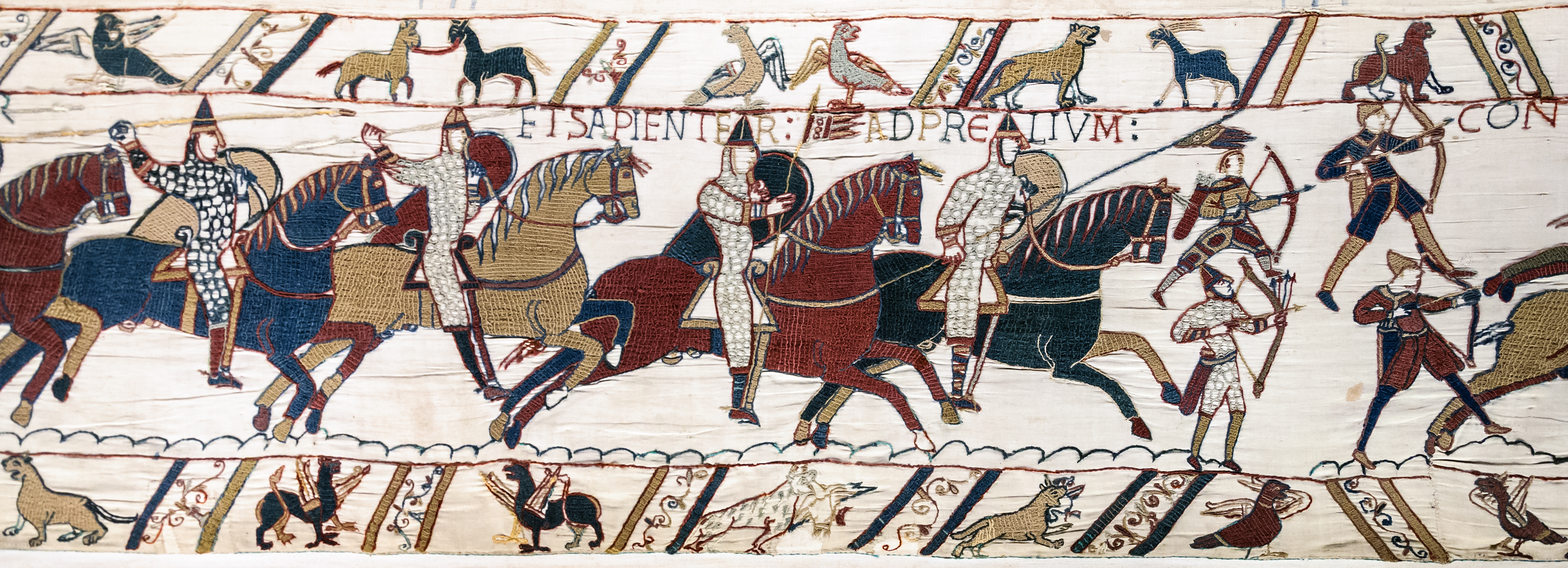
William was duke of Normandy and, as William I, the first Norman king of England. He defeated and killed the last Anglo-Saxon king of England at the Battle of Hastings.
William was born in around 1028, in Falaise, Normandy the illegitimate son of Robert I, Duke of Normandy. He was known as 'William the Bastard' to his contemporaries. On his father's death in 1035, William was recognised as heir, with his great uncle serving as regent. In 1042, he began to take more personal control. From 1046 until 1055, he dealt with a series of baronial rebellions. William's political and military successes helped him in negotiations to marry Matilda, daughter of Count Baldwin of Flanders in 1053.
Early in 1066, Edward, king of England died and Harold, Earl of Wessex was crowned king. William was furious, claiming that in 1051 Edward, a distant cousin, had promised him the throne and that Harold had later sworn to support that claim.
William landed in England on 28 September 1066, establishing a camp near Hastings. Harold had travelled north to fight another invader, Harold Hardrada, King of Norway and defeated him at Stamford Bridge near York. He marched south as quickly as he could and on 14 October, his army met William's. It was a close-fought battle lasting all day, but Harold was killed and his army collapsed. William was victorious and on Christmas Day 1066, he was crowned king in Westminster Abbey. A Norman aristocracy became the new governing class and many members of the native English elite, including bishops, were replaced with Normans.
The first years of William's reign were spent crushing resistance and securing his borders, which he did with ruthless efficiency. He invaded Scotland in 1072 and concluded a truce with the Scottish king. He marched into Wales in 1081 and created special defensive 'marcher' counties along the borders. The last serious rebellion against his rule, the Revolt of the Earls, took place in 1075. In 1086, William ordered a survey to be made of the kingdom. This became known as the Domesday Book and remains one of the oldest valid legal documents in Britain.
With the kingdom increasingly settled, William spent most of his last 15 years in Normandy, leaving the government of England to regents, usually clergymen. He spent the last months of his reign fighting Philip I, King of France. He died on 9 September 1087 from injuries received when he fell from his horse at the Siege of Mantes. He divided his lands between two of his sons, with Robert receiving Normandy and William Rufus, England.

